Demystifying the AI Coding Stack: AI Harnesses vs. The Smarter Project

- Estimated Read Time: ~6 minutes
- Target Audience: Software Engineers, Architects, and Tech Leads
If you’ve been listening to conversations around AI coding tools lately, you’ve probably heard a lot of abstract terminology thrown around: models, agents, harnesses, and environments. To a traditional software engineer, it can sound like an arbitrary soup of buzzwords. Take this question from a recent episode of the Beyond Coding podcast:
“I see us stacking a lot of capabilities. We have the (LLM) model, the agent, the harness around the model specifically. And you’re talking about this environment in which this agent-harness operates?”
What does this architectural stack actually look like under the hood? And how does a platform like The Smarter Project fit into this picture? Is it just another AI harness, or is it something entirely different? The short answer is a qualified, “yes, it’s a harness”, except that it’s also something broader. A harness is one of the major things Smarter provides, but Smarter extends well beyond that into what I’d call an AI application framework.
Let’s break down the AI coding stack using mental models and analogies that every software engineer already understands.
Part 1: Explaining the AI Capabilities Stack
An AI coding system is a set of layers, where each layer adds more functionality and context than the one directly below it. Let’s trace it from the bottom up.
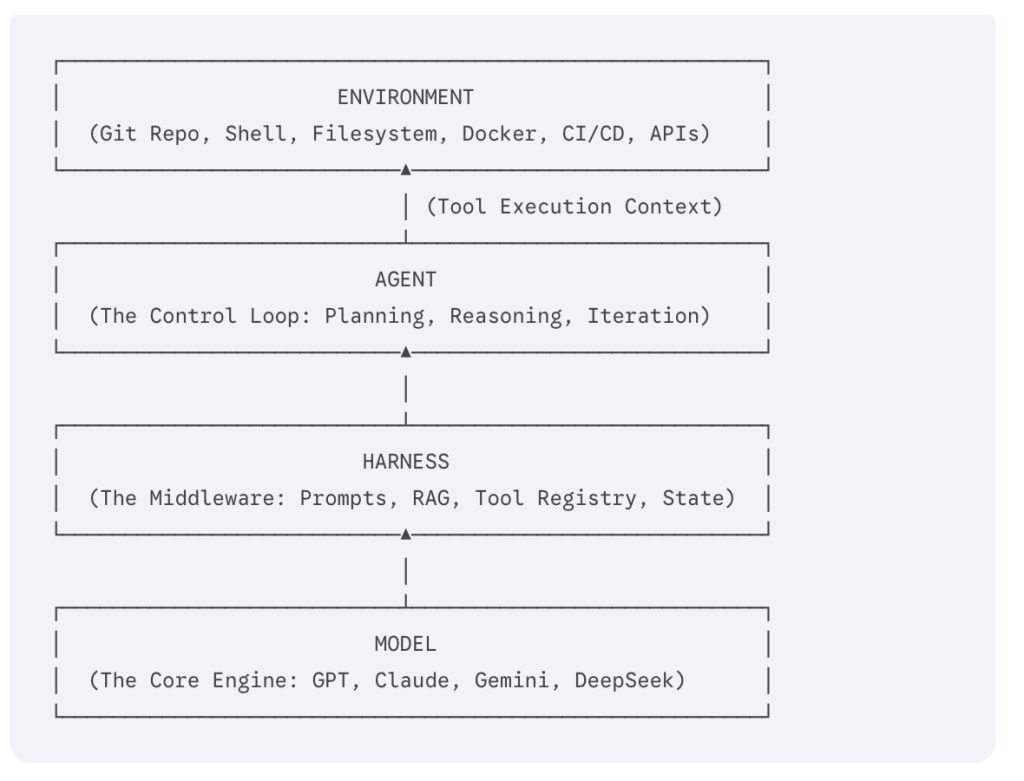
1. The Model
This is the raw Large Language Model (LLM) itself—think GPT-4o, Claude 3.5 Sonnet, or Gemini 1.5 Pro.
- The Engineering Analogy: Think of the model as a pure function or a compiler that accepts code through stdin and prints results to stdout.

- The Reality: By itself, the model is completely stateless. It does not know about your git repository, it cannot read local files, it cannot execute tests, and it retains zero memory outside of what you manually pass into its immediate context window. It only predicts the next sequence of text.
2. The Harness
The harness is the foundational infrastructure wrapped directly around the model to make it useful in a software engineering context.
- The Engineering Analogy: Think of the harness as middleware or a runtime framework. It behaves exactly like a web framework (like Django or Express) sitting around your view logic to intercept, clean up, and route requests.
Rather than a developer interacting with an LLM directly:
Developer –> LLM
The harness steps in to manage the lifecycle of the interaction:
Developer –> Harness –> LLM
The harness handles the operational plumbing that the model is oblivious to:
- Context Management: Assembling prompt templates and maintaining conversation history state.
- Retrieval-Augmented Generation (RAG): Injecting relevant code snippets into the prompt dynamically.
- Tool Definitions: Telling the model what actions it is allowed to take.
- Guardrails: Validating outputs, catching broken JSON, managing token budgets, handling rate-limit retries, and forcing safety checks.
3. The Agent
While the harness provides the capabilities, the agent is the software that decides how and when to execute them.
- The Engineering Analogy: The agent is an asynchronous control loop. Instead of making a single, isolated call to an LLM, it evaluates state iteratively.

- In Practice: If you tell an agent to “Fix the failing unit tests,” the agent initiates a multi-step sequence. It inspects the codebase, reads the error log, instructs the harness to fetch relevant files, requests an edit from the LLM, writes the change, reruns the tests, observes any new failures, and iterates until the compilation or test run passes.
4. The Environment
The environment is the outside world—the entire surface area that the agent is permitted to touch.
- The Engineering Analogy: If the harness is a program’s runtime framework, the environment is the Operating System and external network services.
- Components: This includes things entirely separate from the AI architecture itself: Git repositories, local filesystems, bash shells, Docker containers, package managers (pip, npm), issue trackers (Jira, GitHub Issues), and cloud APIs. The harness exposes this world to the agent safely via structured tools.
Part 2: Putting the Layers Together
To visualize how these capabilities stack during a real development task, let’s look at what happens when you issue a high-level command:
“Upgrade this legacy web application to the latest runtime version.”
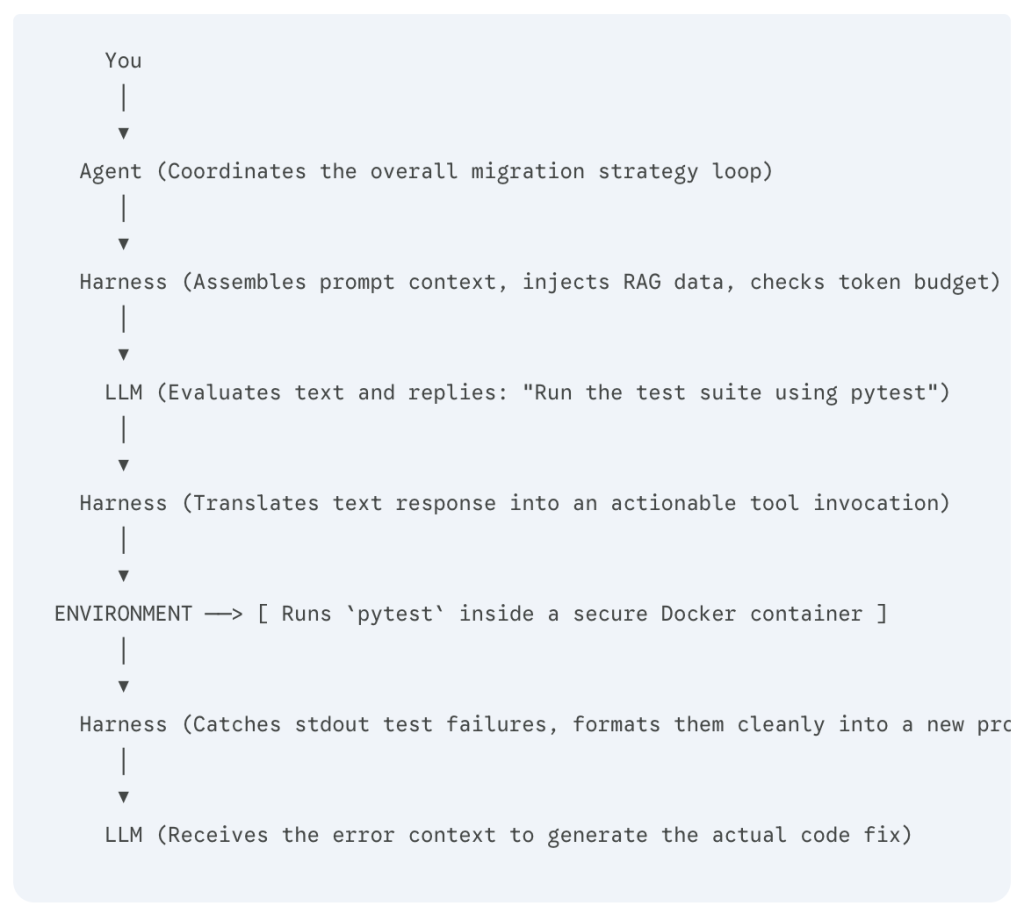
When engineers debate whether they are talking about the internal AI architecture versus the external execution context, they are drawing the line between the harness-agent boundary and the environment it runs against.
Part 3: Where Does “The Smarter Project” Fit In?
Now that we have clean mental models for these layers, we can answer a common question: Is The Smarter Project a harness?
The short answer is yes, but it extends far beyond it.
A traditional harness is typically an implicit, invisible runtime baked directly inside a rigid product (like GitHub Copilot or Claude Code). You don’t manage it; it just handles the API calls behind the scenes.
The Smarter Project takes the entire concept of a harness and turns it into declarative enterprise infrastructure. It treats the harness, the agent configuration, and the environmental tools as code assets that can be versioned, deployed, and governed.
Capability Mapping: The AI Stack vs. Smarter
| Layer | Traditional Responsibility | How The Smarter Project Handles It |
| Model | Token prediction, base logic | Unified Abstraction: Supports switching between major providers (OpenAI, Anthropic, Google, DeepSeek) without rewriting code. |
| Harness | Middleware, state, RAG, tool orchestration | Core Platform Feature: Manages prompt assemblies, plugins, secrets management, governance, auditing logs, and intelligent fallback routing. |
| Agent | Workflows, planning loops | Declarative Agents: Allows engineers to define multi-step reasoning agents and workflow graphs cleanly via configuration. |
| Environment | Real-world system endpoints | Managed Plugins: Seamlessly connects agents to enterprise systems, filesystems, databases, and internal REST APIs through structured manifests. |
| Platform | Lifecycle & Operations (Day 2) | The True Differentiator: Automates provisioning, version control, role-based access control (RBAC), and monitoring of your AI systems. |
The Takeaway for Engineering Teams
If you were explaining The Smarter Project to your engineering team, the best way to frame it is this:
Smarter is a declarative AI application framework that houses an enterprise-grade harness.
Instead of writing brittle wrapper code, managing custom API translation layers, or hardcoding system prompt arrays, Smarter allows you to declare your AI runtimes, tool integrations, and agent workflows using configuration manifests. It handles the operational complexity of running AI applications at scale, allowing your team to focus entirely on building software.