
Django-React Integration

Smarter’s React integration architecture provides a highly optimized,
production-grade bridge between Django’s server-rendered web platform
and modern React-based user interfaces. Rather than treating React as a
disconnected single-page application bolted onto Django, Smarter
implements React as a first-class extension of the Django runtime
itself. The result is a clean, scalable, and operationally efficient
integration strategy that preserves Django’s strengths in
authentication, session management, template rendering, routing, and
industrial-grade server-side orchestration while simultaneously enabling
the development of rich, highly interactive React applications.
A central design goal of Smarter’s integration model is the complete
separation of frontend component development from backend deployment
concerns. React developers are free to build components using standard
modern tooling, while Django transparently assumes responsibility for
runtime asset discovery, manifest analysis, dependency resolution,
template injection, configuration propagation, and environment-specific
hosting concerns. This dramatically reduces integration complexity
inside React components and creates a reusable deployment architecture
that scales consistently across the platform.
At the core of this approach is a sophisticated runtime asset pipeline
built around Vite.js manifest.json build artifact.
Smarter uses custom Django template tags to recursively analyze the
manifest at render time, automatically discovering all required
JavaScript and CSS dependencies — including hashed assets, shared
chunks, vendor bundles, and code-split modules — and injecting the
correct <script> and <link> elements into the Django template.
Because the integration is manifest-driven, React builds remain fully
cache-safe, CDN-compatible, and environment-agnostic without requiring
hardcoded filenames or manual template maintenance.
Smarter’s Vite configuration further extends this architecture by
tightly aligning React’s development and production environments with
Django’s runtime behavior. Build assets are emitted directly into
Django’s static file infrastructure, development proxies transparently
route API traffic to Django, production builds automatically strip
debugging statements, and optional CloudFront deployment workflows
support globally distributed CDN hosting. The system also supports hot
module replacement for an efficient frontend developer experience while
preserving full compatibility with Django’s authentication, CSRF and
other middleware protection mechanisms.
The integration boundary between Django and React is intentionally
lightweight and elegant. Django templates provide stable DOM mounting
points for React applications and serialize server-side runtime context
into custom HTML attributes. During initialization, React reads these
attributes and converts them into component props, allowing
backend-generated context — including API endpoints, session metadata,
CSRF configuration, feature flags, and runtime settings — to flow
naturally into the frontend without additional bootstrap APIs or inline
JavaScript payloads.
Importantly, the Django view layer remains deliberately thin throughout
this process. Views focus primarily on authentication, routing, template
selection, and generation of runtime configuration context. Complex
frontend integration concerns are abstracted into reusable template tags
and Vite build conventions, resulting in a clean separation of
responsibilities between backend orchestration and frontend
presentation.
Collectively, these mechanisms form a generalized React integration
framework that enables Smarter to rapidly deploy sophisticated
React-driven functionality throughout the platform while maintaining
operational consistency, strong security guarantees, predictable
deployment behavior, and exceptionally low integration overhead.
An Example: The Terminal Application Component
Lets tie the pieces together with a concrete example that illustrates:
manifest analysis, Vite configuration, custom Django template tags,
template mounting strategies, and server-side context propagation. These
five elements work in concert to bring dazzling React-based
functionality into the Smarter web console.
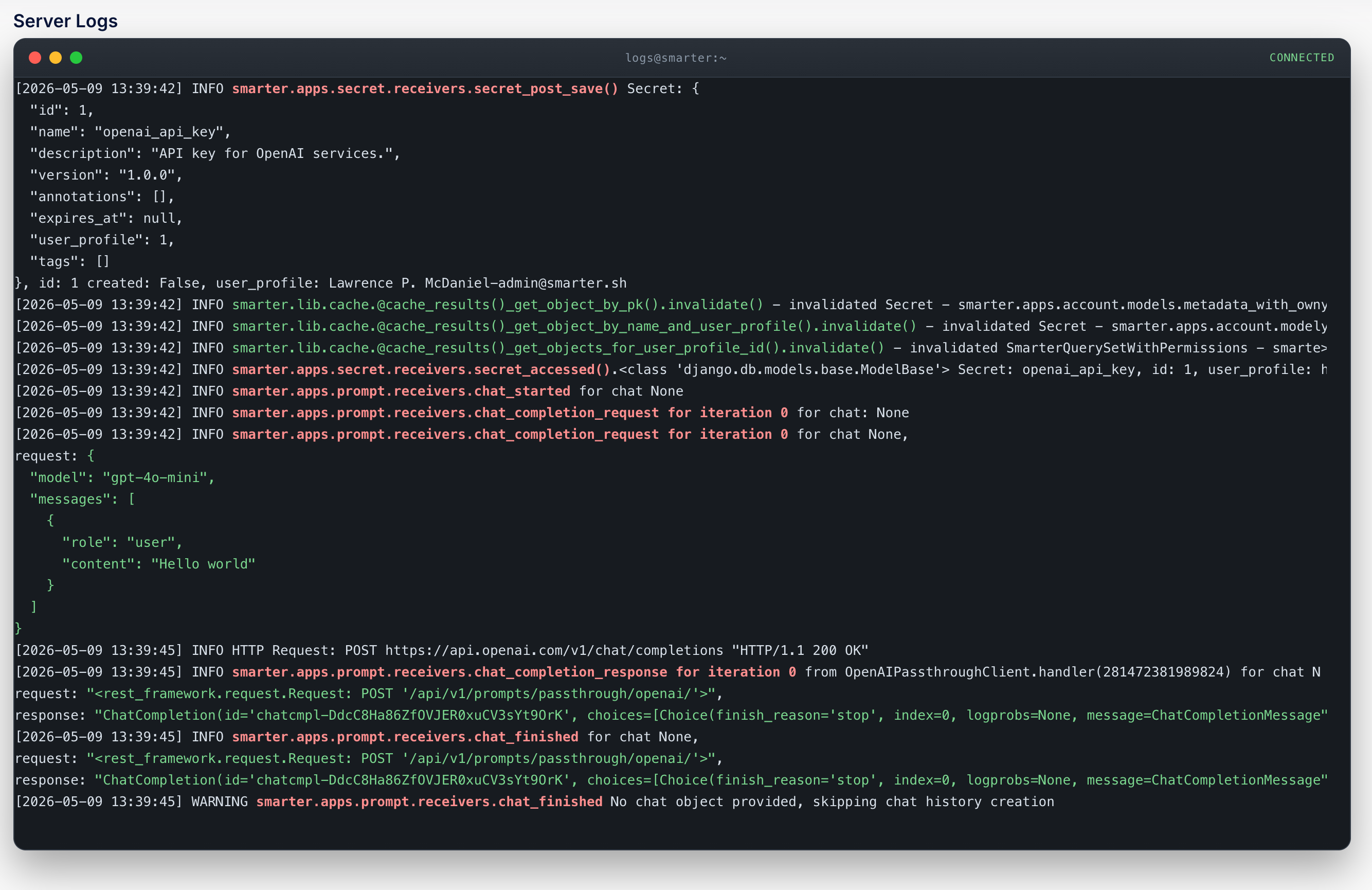
Smarter’s live view of server log activity is a great example, in that
it is a highly interactive React component that involves live streaming
data, complex state management, and tight integration with Django’s
authentication and server-side context management. Functionality of this
nature could only be implemented in a frontend framework like React.
React Build Manifest
The React build’s manifest.json build artifact is generated by Vite.js
(hereon, Vite) and provides a single source of truth for the names and
locations of all JavaScript and CSS build assets. It is important to
recognize that the contents of a manifest.json file can vary widely
depending on the extent to which it combines other 3rd party modules and
assets. Moreover, the individual asset filenames are hashed and thus are
necessarily indeterminate in order to prevent browser caching issues.
Following is an example manifest.json file for the Terminal Application:
{
  "_rolldown-runtime-B3igc2qu.js": {
    "file": "assets/rolldown-runtime-B3igc2qu.js",
    "name": "rolldown-runtime"
  },
  "_xterm-D5XSfLrr.js": {
    "file": "assets/xterm-D5XSfLrr.js",
    "name": "xterm",
    "imports": [
      "_rolldown-runtime-B3igc2qu.js"
    ],
    "css": [
      "assets/xterm-kHJ-D0s7.css"
    ]
  },
  "_xterm-kHJ-D0s7.css": {
    "file": "assets/xterm-kHJ-D0s7.css",
    "src": "_xterm-kHJ-D0s7.css"
  },
  "index.html": {
    "file": "assets/index-CZK_Bxxh.js",
    "name": "index",
    "src": "index.html",
    "isEntry": true,
    "imports": [
      "_rolldown-runtime-B3igc2qu.js",
      "_xterm-D5XSfLrr.js"
    ],
    "css": [
      "assets/index-58MXwt-L.css"
    ]
}
One and only one top-level key will contain a dict with an “isEntry”
key set to true. This is the entry point for the React component, and
the objects which should be recursively analyzed to determine the
complete set of build assets to add to the Django template. Analysis of
this nature is handled by custom Django template tags (see below).
Vite Configuration
The manifest.json file is generated by Vite.js, and
its structure and contents are determined entirely by the Vite build
configuration. Vite is a high-performance frontend build system that
Smarter uses to compile, optimize, and package React applications for
integration into the Django web console.
Smarter’s Vite configuration serves as a critical integration layer
between the React frontend and the Django backend. Rather than embedding
deployment logic directly into React applications, Smarter centralizes
these concerns inside the build pipeline itself. This creates a clean
separation of concerns that allows React components to be developed
largely independently from the details of how assets are hosted,
versioned, discovered, and injected into Django templates at runtime.
Integrating React into a server-rendered Django platform introduces
several architectural and operational challenges, including:
- Manifest Generation: Producing a manifest.json file containing hashed asset filenames
that serve as the authoritative source of truth for all
JavaScript, CSS, and chunk dependencies generated during the
build. - Development Proxying: Configuring proxy routes so that API requests originating from the
Vite development server are transparently forwarded to the Django
backend instead of the frontend development server. - Static Asset Integration: Building React assets directly into Django’s static file hierarchy
so that compiled frontend resources participate in Django’s
collectstatic workflow and are served consistently alongside the
rest of the platform. - Security Compatibility: Preserving compatibility with Django’s authentication, CSRF
protection, session cookies, and same-origin security model by
avoiding unnecessary cross-origin frontend deployments. - CDN Deployment: Optionally synchronizing production build artifacts to a public
AWS CloudFront distribution backed by S3 for globally distributed,
low-latency asset delivery. - Production Hardening: Removing console.debug() statements from production bundles in
order to reduce unnecessary console noise and avoid leaking
potentially sensitive runtime information. - Caching Optimization: Splitting large third-party dependencies such as xterm.js into
isolated bundles so that vendor assets can remain browser-cached
independently from frequently changing application code. - Developer Experience: Supporting hot module replacement (HMR) and rapid incremental
rebuilds to provide a fast and efficient React development
workflow without compromising Django runtime compatibility.
The following example illustrates the Vite configuration used by the
Terminal Application component.
const postBuildPlugin: PluginOption = {
  name: "post-build",

  closeBundle() {
    if (packageJson.config.cdnDeploy === true) {
      execSync(
        `aws s3 sync ../../smarter/static/react/${packageName} ${packageJson.config.s3BucketPath} --acl public-read --delete`,
        { stdio: "inherit" },
      );
      execSync(
        `aws --no-cli-pager cloudfront create-invalidation --distribution-id ${packageJson.config.cloudfrontDistributionId} --paths '/react/${packageName}/*'`,
        { stdio: "inherit" },
      );
    }
  },
};

export default defineConfig(({ command }: ConfigEnv) => ({
  plugins: [
    react(),
    postBuildPlugin,
  ],
  // We use esbuild to remove console.debug statements in production builds
  // in order to avoid leaking potentially sensitive information in
  // production environments.
  esbuild: {
    pure: ["console.debug"],
  },
  // Builds are also saved into the Django static directory so that these
  // files can be included in the Django collectstatic process and served by
  // Django at runtime in local development environments. For development
  // we need to be able to support serving these files both from the Vite
  // dev server as well as the Django dev server. We set the base to '/'
  // so that Vite's dev server can serve these files. Separately, we persist
  // the actual build files to the Django static directory and set up a proxy
  // in the Vite dev server to forward requests to the Django dev server.
  base: command === "serve" ? "/" : `/static/react/${packageName}/`,
  resolve: {
    alias: {
      "@": path.resolve(__dirname, "./src"),
    },
  },
  build: {
    minify: "esbuild" as const,
    // ------------------------------------------------------------------------
    // The manifest is needed for hosting builds from Django (both dev and prod).
    // It is used by Django templatetags to determine the correct file names to include
    // in the HTML template. This is necessary because Vite includes a
    // hash in the file names for cache busting.
    // ------------------------------------------------------------------------
    manifest: "manifest.json",
    // ------------------------------------------------------------------------
    // we're placing our build output in the primary Django static directory so
    // that these files are automatically included in the Django collectstatic
    // process and served by Django at runtime.
    //
    // In development, we rely on Vite's dev server to serve these files, so we
    // set the outDir to a directory that is not used by the Django dev server.
    // ------------------------------------------------------------------------
    outDir: `../../smarter/static/react/${packageName}`,
    emptyOutDir: true,
    // ------------------------------------------------------------------------
    // We want to bundle xterm.js and its addons separately from the rest of the
    // application code in order to optimize caching. This way, if we make changes
    // to our application code, the xterm.js bundle can still be cached by the
    // browser and won't need to be re-downloaded.
    // ------------------------------------------------------------------------
    rollupOptions: {
      output: {
        entryFileNames: "assets/[name]-[hash].js",
        chunkFileNames: "assets/[name]-[hash].js",
        assetFileNames: "assets/[name]-[hash][extname]",
        manualChunks(id: string) {
          if (id.includes("node_modules/xterm") || id.includes("node_modules/@xterm")) {
            return "xterm";
          }
          return undefined;
        },
      },
    },
  },
  // Django collects static files and serves them from /static/
  // We need to create proxy servers in React's dev environment
  // so that these requests are served from the Django dev server instead
  // of the React dev server.
  //
  // Most of these cases stem from <link> elements added to this index.html
  // containing platform-wide stylesheets and scripts that originate from
  // and are served by the Django dev server. These are added to index.html
  // in order to keep this React dev environment as close to the runtime
  // environment as possible.
  server: {
    proxy: {
      "/api": "http://localhost:9357",
      "/assets": {
        target: "http://localhost:9357", // Django dev server
        changeOrigin: true,
        rewrite: (path: string) => `/static${path}`,
      },
      "/common-styles.css": {
        target: "http://localhost:9357",
        changeOrigin: true,
        rewrite: (path: string) => `/static${path}`,
      },
      "/dashboard/": "http://localhost:9357",
      [`/static/react/${packageName}/`]: {
        target: "http://localhost:5173",
        changeOrigin: true,
        rewrite: (path: string) => path.replace(new RegExp(`^/static/react/${packageName}/`), "/"),
      },
      "/static": {
        target: "http://localhost:9357",
        changeOrigin: true,
      },
      "/workbench/": "http://localhost:9357",
    },
  },
}));
Django Template Tags
Django template tags are a server-side extensibility mechanism that
allows developers to embed executable Python-backed logic directly into
Django templates using a declarative syntax such as {% tag_name %}.
Custom template tags are especially useful for dynamically processing a
React manifest.json file generated by modern frontend build tools like
Vite or Webpack, because the manifest provides a machine-readable
mapping between original source entry points and their versioned
production assets. A Django template tag can load and parse the manifest
at render time, identify the correct JavaScript and CSS bundles
associated with a specific React entry point, and automatically inject
the appropriate <script> and <link> elements into the HTML template.
This approach eliminates hardcoded asset filenames, enables cache
busting through hashed asset names, supports code splitting and
lazy-loaded chunks, and creates a clean integration layer between
Django’s server-rendered templates and React’s compiled frontend assets.
Following is an example of how Smarter’s custom template tags are used
as an iterator that generates the CSS and JS asset paths and filenames
for the Terminal App React component. Effectively, the custom template
tag code logic provides a clean interface for the Django template to
interact with the manifest.json file, abstracting away the details of
how to recursively parse the manifest and generate the correct asset
paths and filenames.
{% block style_extra %}
  {{ block.super }}

  {% terminal_emulator_react_assets as assets %}
  {% for css_file in assets.css %}
    <link class="smarter" rel="stylesheet" href="{% static 'react/terminal_emulator/' %}{{ css_file }}">
  {% endfor %}
{% endblock %}
{% block javascript_extra %}
{{ block.super }}
{% terminal_emulator_react_assets as assets %}
{% for js_file in assets.js %}
<script class="smarter" type="module" src="{% static 'react/terminal_emulator/' %}{{ js_file }}"></script>
{% endfor %}
{% endblock %}See
SmarterReactTemplateTagManager <lib/django/templatetags>{.interpreted-text
role=”doc”}.
Django Template
The Django template is primarily responsible for providing a DOM entry
point for the React component to mount to. It is secondarily responsible
for mapping Django view context to custom HTML attributes on the DOM
element that serves as the mounting point for the React component. These
custom attributes function as a transport layer for React props,
allowing server-side Django context data to be passed into the
client-side React application during React component initialization.
When the React application boots, it locates the mounting element in the
DOM and reads these attributes using standard browser APIs such as
Element.getAttribute() or HTMLElement.dataset. The extracted values are
then transformed into React props and supplied to the root component.
This pattern provides a lightweight integration boundary between Django
and React without requiring inline JavaScript bootstrapping or
additional API calls during initial page load. This all happens
lightning fast.
This context information typically includes salient cookie names for
Django session management, CSRF protection, authenticated API
communication, feature flags, endpoint URLs, and any other configuration
values required by the React component at runtime.
<div
  id="smarter-terminal-emulator-root"
  smarter-api-path="/dashboard/logs/api/stream/"
  smarter-cookie-domain="alpha.platform.example.com"
  smarter-csrf-cookie-name="csrftoken"
  smarter-django-session-cookie-name="sessionid"
>
Django View
The Django view is responsible for mapping the URL endpoint to the
Django HTML template and for generating the server-side context consumed
by that template. In this architecture, the view layer is intentionally
kept thin and focused primarily on request orchestration, template
selection, authentication, and serialization of runtime configuration
values required by the React frontend.
The view assembles a context dictionary containing configuration and
integration metadata, including cookie names, CSRF settings, API
endpoints, and DOM identifiers. These values are subsequently rendered
into custom HTML attributes by the Django template, where they become
available to the React application as initialization props during the
client-side bootstrap process.
A live example of a Django view that serves the dashboard template:
class TerminalEmulatorLogView(SmarterAuthenticatedNeverCachedWebView):
def get(self, request: HttpRequest, *args, **kwargs) -> HttpResponse:
context = {
"terminal": {
"root_id": "smarter-terminal-emulator-root",
"csrf_cookie_name": settings.CSRF_COOKIE_NAME, # this is the CSRF token cookie that should be included in the header of the POST request from the frontend.
"django_session_cookie_name": settings.SESSION_COOKIE_NAME, # this is the Django session.
"cookie_domain": settings.SESSION_COOKIE_DOMAIN,
"api_url": "/path/to/log/stream/", # the WebSocket endpoint with the log data stream.
}
}
self.template_path = "react/terminal-emulator.html"
return render(request, self.template_path, context=context)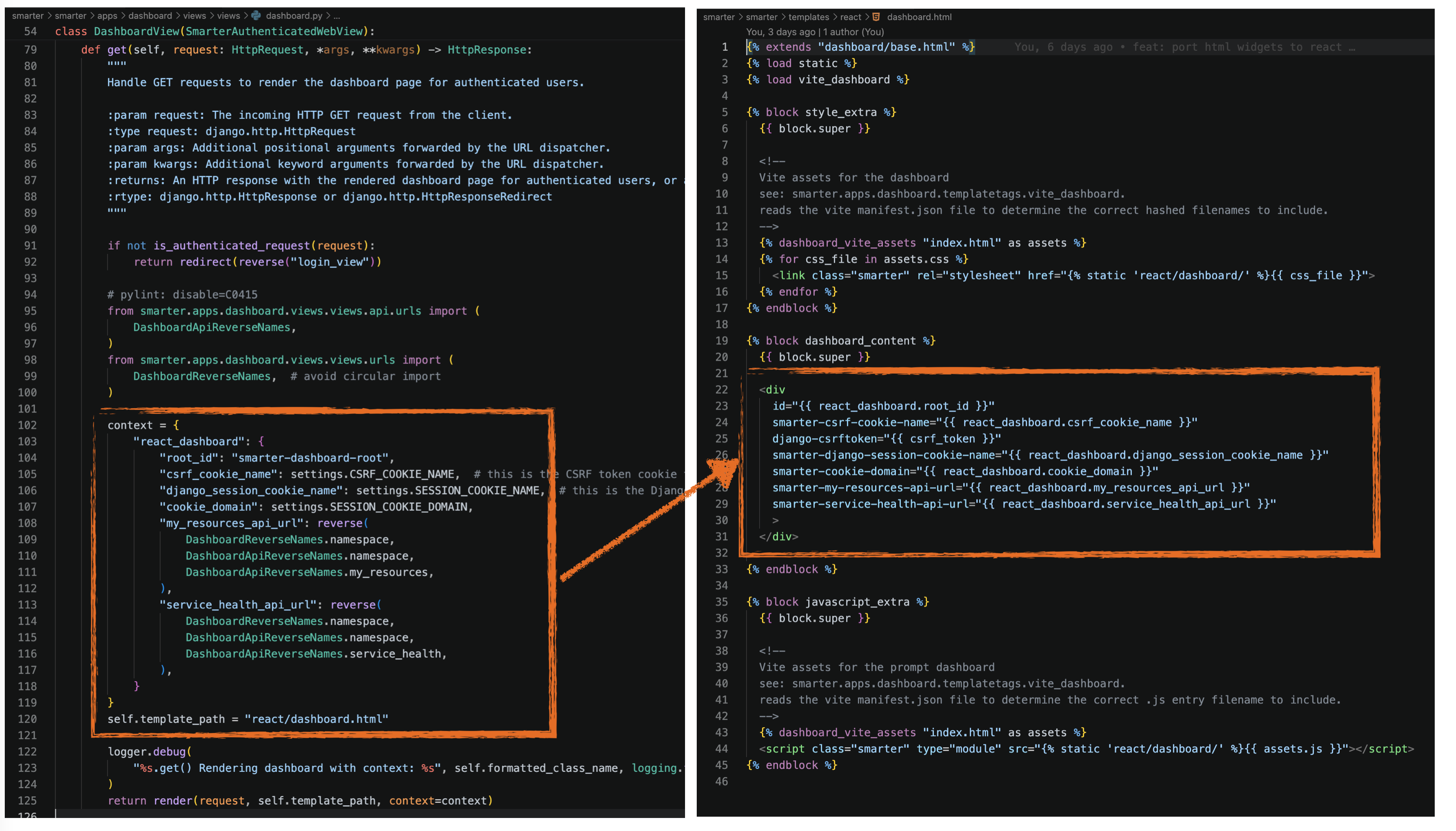 {width=”100.0%”}
Build-Deploy and CI-CD Considerations
From Django’s perspective, compiled React assets are ultimately treated
no differently than any other static resource such as CSS, images, or
JavaScript files. This architectural decision is intentional and is
central to Smarter’s integration strategy. By ensuring that React build
artifacts are emitted directly into Django’s static file hierarchy
before the collectstatic process runs, the React build pipeline can
remain cleanly decoupled from the Django application runtime itself.
This separation provides several operational advantages. React
applications can be developed, versioned, and rebuilt independently
while still integrating seamlessly into Django’s deployment pipeline. At
runtime, Django remains fully responsible for static asset serving,
cache management, CDN integration, and template rendering, while React
remains focused exclusively on frontend behavior and presentation logic.
There are several important operational considerations related to the
build, deployment, and CI/CD lifecycle of React applications within the
Smarter platform:
- Source Control Exclusion: Compiled React build artifacts are intentionally excluded from the
Git repository and are never committed to source control. Build
outputs are considered ephemeral deployment artifacts and must
therefore be regenerated as part of the build process. - Build Prerequisites: Because Django templates and template tags depend on the existence
of manifest.json and its associated static assets, the React build
process must execute successfully at least once before the Django
application can correctly render React-integrated pages. Keep this
in mind when for example, you are tinkering with versions in
package.json. - CI/CD Pipeline Initialization: GitHub Actions workflows begin with a clean repository checkout
that does not contain compiled frontend assets. Accordingly, React
build steps must run early in the workflow before Docker builds,
collectstatic, integration tests, or deployment stages that depend
on these assets. - Static File Synchronization: During local development, developers should remain aware of the
distinction between Vite’s live development server, Django’s
static asset directories, and the Django staticfiles runtime
directory. Stale build artifacts can occasionally lead to
confusing runtime behavior if these environments become out of
sync. - Container Build Dependencies: Docker images intended to serve React-enabled Django pages must be
built only after the frontend asset pipeline has completed. This
ensures that all compiled React bundles and manifest metadata are
available inside the container image at runtime. - Convenience Tooling: Smarter provides helper commands such as [make
react-build]{.title-ref} and [make
docker-build-for-react]{.title-ref} to simplify common frontend
integration workflows and to keep Django’s static directories
aligned with current React build outputs.
Collectively, these conventions provide a predictable and highly
reproducible deployment model that works consistently across local
development environments, CI/CD workflows, Docker container builds, and
production infrastructure. The result is a React integration
architecture that preserves the operational simplicity of Django
deployments while still enabling modern frontend build pipelines and
advanced React development workflows.
::: {.toctree maxdepth=”1″ caption=”Technical Reference”}
react-integration/dashboard react-integration/prompt-list
react-integration/terminal-application
react-integration/prompt-passthrough react-integration/smarter-chat
lib/django/templatetags
:::
::: {.toctree maxdepth=”1″ caption=”Code Samples”}
react-integration/example-vite react-integration/example-template-tag
react-integration/example-template react-integration/example-view
react-integration/example-react-mount
:::